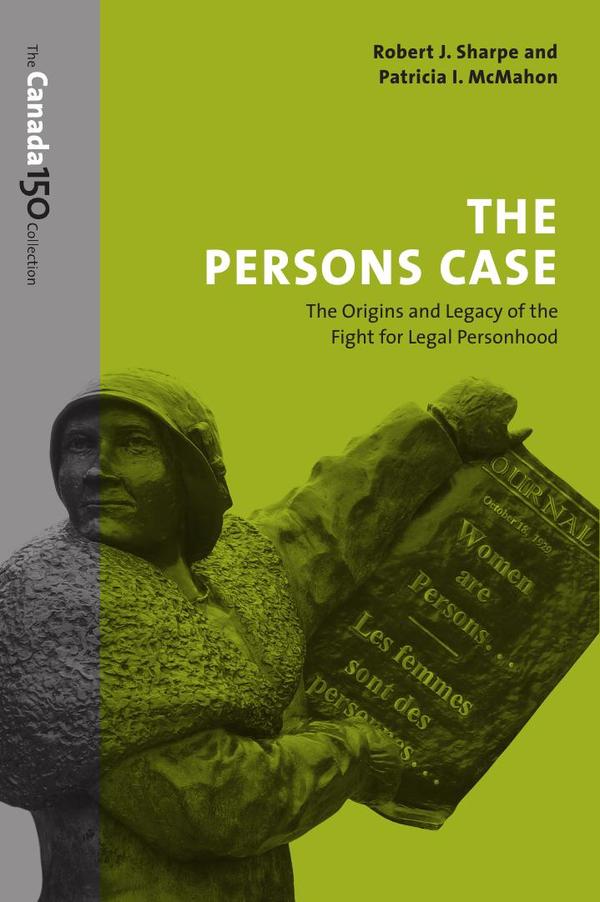
On 18 October 1929, John Sankey, England's reform-minded Lord Chancellor, ruled in the Persons case that women were eligible for appointment to Canada's Senate. Initiated by Edmonton judge Emily Murphy and four other activist women, the Persons case challenged the exclusion of women from Canada's upper house and the idea that the meaning of the constitution could not change with time. The Persons Case considers the case in its political and social context and examines the lives of the key players: Emily Murphy, Nellie McClung, and the other members of the "famous five," the politicians who opposed the appointment of women, the lawyers who argued the case, and the judges who decided it._x000D__x000D_Robert J. Sharpe and Patricia I. McMahon examine the Persons case as a pivotal moment in the struggle for women's rights and as one of the most important constitutional decisions in Canadian history. Lord Sankey's decision overruled the Supreme Court of Canada's judgment that the courts could not depart from the original intent of the framers of Canada's constitution in 1867. Describing the constitution as a "living tree," the decision led to a reassessment of the nature of the constitution itself. After the Persons case, it could no longer be viewed as fixed and unalterable, but had to be treated as a document that, in the words of Sankey, was in "a continuous process of evolution."_x000D__x000D_The Persons Case is a comprehensive study of this important event, examining the case itself, the ruling of the Privy Council, and the profound affect that it had on women's rights and the constitutional history of Canada.
Book information
- Author: SHARPE ROBERT J.
- Publisher: University of Toronto Press - 35
- Imprint: University of Toronto Press
- ISBN-13: 9781487522391
- Language: EN
- Edition: 1
- Publication date: 2017-05-24
- Pages: 302
- Format: 152 × 229 mm