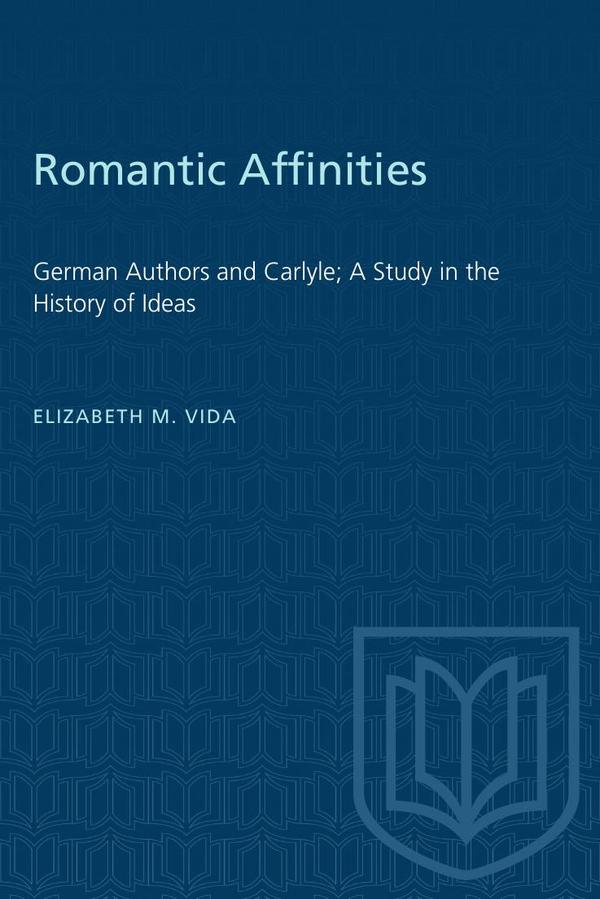
And how he studied us Germans! He is almost more at home in our literature than we are ourselves. (Eckermann, Coversations, 11 October 1892, as quoted in Romantic Affinities, p. 298).Carlyle saw German Romanticism as a continuation of Goethe's efforts to oppose the rationalistic tendencies of the Enlightenment. the fusion of philosophy and poetry in German literature and its novelty in concept and form attracted Carlyle and became central to his emblematic vision.In Romantic Affinities E.M. Vida re-evaluates the contribution of German literature and philosophy to Carlyle's early literary work. She examines Essays, German Romance, Sartor Riartus, Heroes, and Past and Present, and traces in these works of the influence of a wide range of authors, from Goethe, Jean Paul [Friedrich Richter], and Novalis, to Ludwig Tieck, E.T.A. Hoffmann, Fichte, Fouqué, Wilhelm Hauff, and the critic Friedrich Schlegel.Influences in works of German literature which Carlyle actually read, or may be presumed to have known on the basis of internal evidence, include a German philosophy of clothes, eccentric originals and their editors, German spiritual biographies, renunciation as a way of life, the notion of Palingenesia or rebirth of society, and additional references to the Everlasting No and Yea. Vida reveals how Carlyle combined and reshaped these heterogeneous influences to suit his own artistic and literary ends.
Book information
- Author: Vida
- Publisher: University of Toronto Press - 35
- Imprint: University of Toronto Press
- ISBN-13: 9781487573270
- Language: EN
- Edition: 1
- Publication date: 1993-12-15
- Pages: 274
- Format: 156 × 234 mm